>
>
Harmonised Protocols and AI Are Now the Paracetamol for the Headache of Study Start-Up
Harmonised Protocols and AI Are Now the Paracetamol for the Headache of Study Start-Up
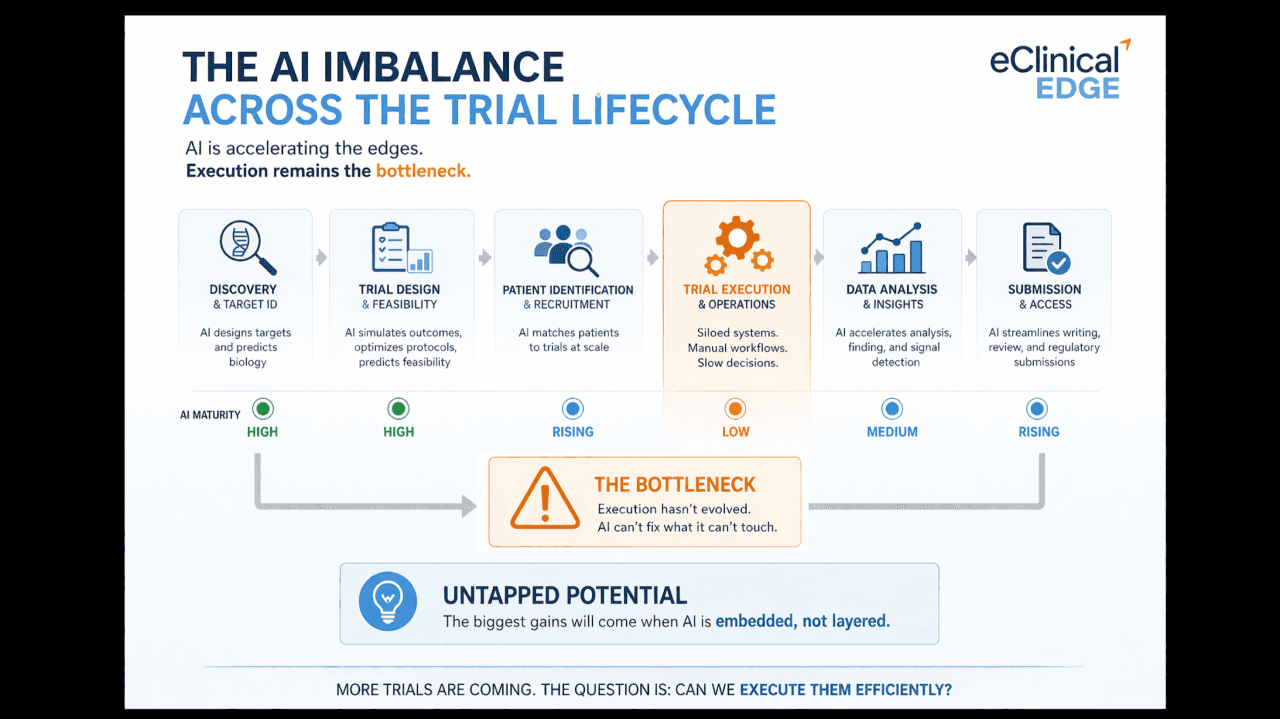
Clinical trial start-up — the phase encompassing vendor onboarding, system build and configuration, site activation and training — persistently consumes time, introduces friction and contributes to costly delays in getting first patient in. For decades this has been driven by an industry-wide reliance on narrative, unstructured protocols and disconnected operational hand-offs.

Clinical trial start-up — the phase encompassing vendor onboarding, system build and configuration, site activation and training — persistently consumes time, introduces friction and contributes to costly delays in getting first patient in. For decades this has been driven by an industry-wide reliance on narrative, unstructured protocols and disconnected operational hand-offs.
Today, two developments are emerging as a pragmatic, near-term remedy that can measurably reduce this friction: (1) globally harmonised, structured clinical trial protocols under ICH M11 CeSHarP and (2) budgeted, governed use of AI tools such as large language models in defined operational roles.
This article explains what these are, why they matter, how they align with regulatory thinking, and how providers can start integrating them into their start-up workflows.
Why Study Start-Up Still Hurts
At its core, study start-up is a coordination problem. A typical trajectory from protocol finalisation to site activation includes:
Translating protocol content into technical build specifications for IRT, eCOA and EDC systems
Onboarding vendors with requirements documents that are manually extracted from narrative text
Conducting UAT to validate system configurations
Creating training and site activation materials that mirror the protocol
In most organisations, this process is heavily manual. Teams extract protocol elements by reading thousands of pages and re-typing them into secondary documents or systems. When any interpretation differs — due to vague narratives or missing structure — that leads to additional clarification cycles. These “interpretation ping-pong” loops are where much of the time and cost in study start-up is spent.
This analog process has persisted in part because there has been no commonly adopted, harmonised structure for protocols across regulatory regions — until now.
What Are Harmonised Protocols? Introducing ICH M11 CeSHarP
The International Council for Harmonisation (ICH) has finalised a new guideline designed specifically to tackle protocol variability and ambiguity. The M11 Clinical Electronic Structured Harmonised Protocol (CeSHarP) consists of three components: a guideline describing structured protocol principles, a harmonised template and a technical specification that enables interoperable electronic exchange. This represents the first internationally harmonised standard for clinical trial protocol structure and content.
Key points about M11:
It creates a standardised template and table of contents with defined headers, content expectations and structured data elements.
The accompanying technical specification enables open, non-proprietary electronic exchange of structured protocol content between systems and stakeholders.
The standard is designed to be acceptable to all regulatory authorities in ICH regions and aids communication across sponsors, vendors, regulators, ethics committees, sites and investigators.
For reference, the FDA draft guidance for the M11 Template (Clinical Electronic Structured Harmonised Protocol) can be found here: https://www.fda.gov/regulatory-information/search-fda-guidance-documents/m11-template-clinical-electronic-structured-harmonised-protocol
An overview from the European Medicines Agency describes the harmonised guideline and technical specifications here: https://www.ema.europa.eu/en/ich-m11-guideline-clinical-study-protocol-template-technical-specifications-scientific-guideline
The core principle is simple: replace thousands of pages of narrative text with a structured, predictable, machine-interpretable protocol backbone acceptable across regions. This reduces ambiguity at the source.
How Harmonised Protocols Reduce Startup Friction
ICH M11’s structured template and technical specification tackle several root causes of study start-up delays:
Consistent Structure All stakeholders use the same order of sections, terminology and data expectations, so interpretation differences are reduced.
Interoperability-Ready Data Protocol content becomes fielded and machine-readable — meaning it can be extracted, shared and repurposed reliably across systems rather than cut-and-pasted from narrative text.
Electronic Exchange The technical specification defines data attributes such as cardinality and conformance for structured elements, improving the ability to transmit content directly between software tools.
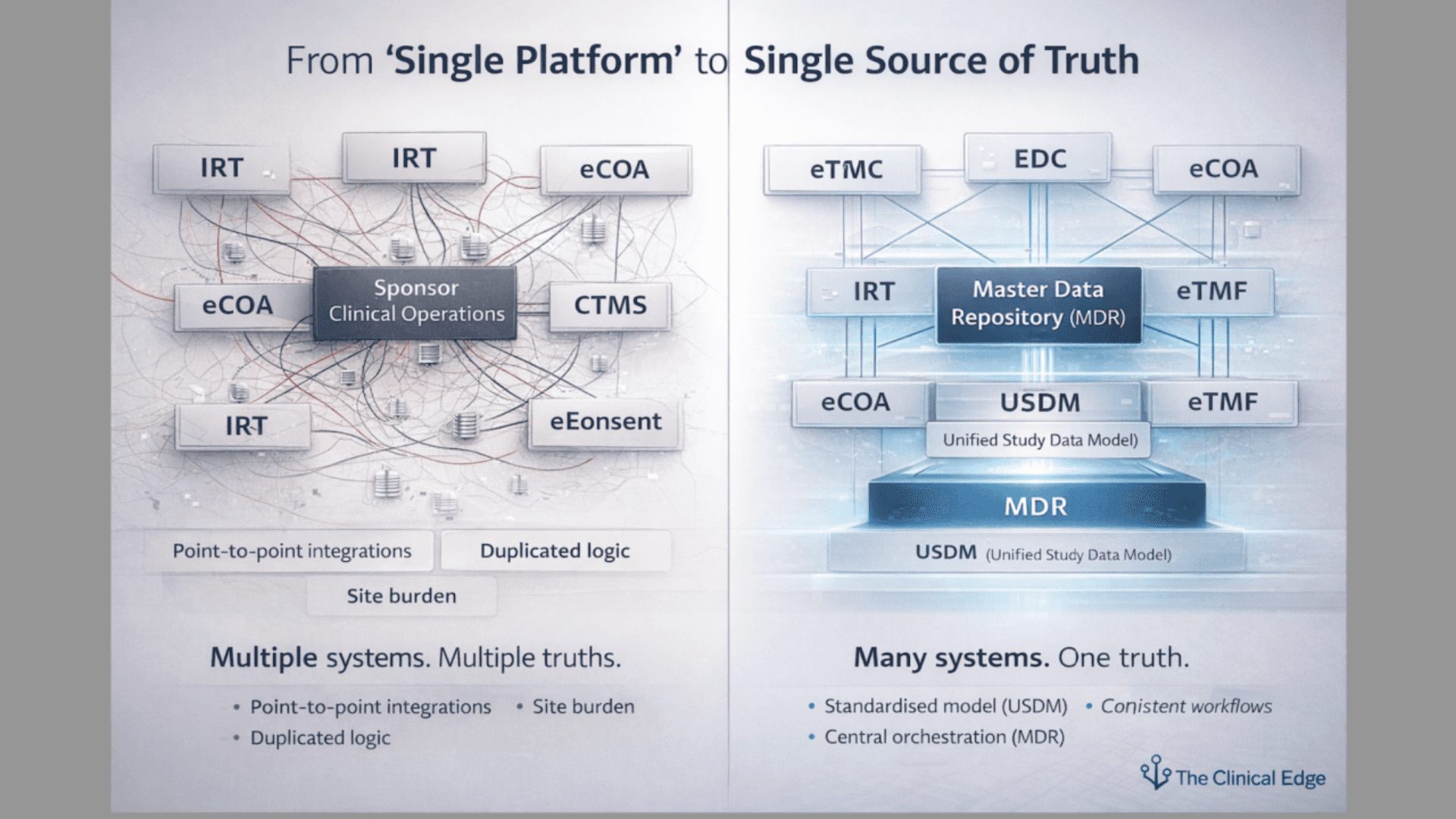
By converting protocols into structured formats at the earliest stage, teams gain a single source of truth from which all downstream artefacts — vendor specifications, build outlines, site packs — can be derived. This approach moves study start-up from an analog data flow to a digital, interoperable one, reducing manual re-entry and the risk of misinterpretation. (European Medicines Agency (EMA))
Additionally, collaborative efforts between ICH and organisations like CDISC to support controlled terminology governance for M11 further reinforce industry convergence on harmonised standards: https://www.businesswire.com/news/home/20240718403503/en/ICH-and-CDISC-Collaborate-to-Support-the-Maintenance-and-Governance-Process-for-ICH-M11-Controlled-Terminology (Business Wire)
Introducing AI: Smart Assistance, Not Magical Fixes
Artificial intelligence — especially generative AI and large language models (LLMs) — have demonstrated practical value in accelerating specific operational tasks in clinical research workflows, including areas directly relevant to study start-up. According to recent industry observations, pharmaceutical companies are applying AI to streamline documentation, participant identification and regulatory reporting tasks, reducing administrative timeframes by weeks in some cases: https://www.reuters.com/legal/litigation/drugmakers-turn-ai-speed-trials-regulatory-submissions-2026-01-26/
While these applications are operationally promising, it is essential to position AI accurately in a regulated environment: governed, human-in-the-loop, context-bound and traceable.
A recent peer-reviewed report on building safe, transparent workflows for LLM-assisted clinical trials emphasises the importance of governance mechanisms — including scope definition, model benchmarking, audit trails and expert quality gates — when introducing AI into regulated processes. This reflects industry trends toward enabling AI use while maintaining scientific rigour and compliance. https://pubmed.ncbi.nlm.nih.gov/41111869/
In practice, AI can assist start-up workflows in ways such as:
Structured Extraction Converting narrative content into structured protocol fields relevant for machine consumption.
Consistency Checking Identifying mismatches between protocol sections, such as inconsistencies in visit schedules or endpoint definitions.
Draft Specification Generation Creating initial, structured editions of build specifications for systems like IRT and eCOA that subject matter experts can review and refine.
Training Material Drafts Generating role-based training drafts tied to specific structured elements of the protocol.
It is critical to emphasise that AI should not be the source of truth itself — it should augment human experts by handling repetitive extraction and pattern detection tasks while leaving final decisions to domain professionals with audit trails.
Combining Harmonised Protocols and AI for End-to-End Efficiency
The real operational value emerges when structured protocols and AI-assisted workflows are used together. Consider the following improvements:
1. Vendor Onboarding
In a traditional workflow, sponsor teams extract system requirements from narrative text manually and provide them to vendors in bespoke documents. With harmonised, structured protocols, this data can be exported in machine-readable form. AI can assist by:
Pulling relevant fields directly from structured protocol sections
Generating draft build outlines for review
Highlighting missing or ambiguous areas requiring clarification
This shortens turnaround time and reduces cycles of rework.
2. System Build and UAT
IRT, eCOA and other system builds hinge on precise interpretation of protocol schedules, eligibility criteria, arms and endpoints. When these elements are structured and consistently defined, they can feed directly into configuration templates. AI can help by:
Mapping structured elements to specific build artefacts
Checking for logical conflicts (e.g., visit timing mismatches)
Producing consistency reports for UAT readiness
3. Site Activation and Training
Site activation packs and training materials are often built manually from protocol text. Structured protocols allow:
Automated extraction of relevant sections for site procedures
AI generation of training drafts tied to specific structured items
Standardised site checklists that reduce variability
Together, structured data and AI assistance replace manual narrative interpretation with semiautomated generation pipelines, significantly reducing friction.
Operational Resilience: Handling Change Without Collapse
The benefits extend beyond point-to-point efficiencies. Harmonised protocols and AI help create operational resilience — the ability to absorb change without disarray. Examples include:
Protocol amendments that propagate through downstream artefacts reliably
Greater clarity for vendors and sites when requirements change
Reduced error rates in documentation hand-offs
Faster training updates when design changes occur
Resilience proxies such as number of rework cycles, protocol interpretation queries and time from protocol finalisation to build readiness can be tracked as part of continuous improvement efforts.
Conclusion: A Measured Remedy for a Longstanding Pain
The combination of ICH M11 CeSHarP harmonised protocols and governed AI workflows does not promise instant transformation, but it pragmatically addresses some of the core contributors to start-up friction: inconsistent interpretation, repetitive manual extraction, and disconnected systems.
By moving toward structured, interoperable protocol content and using AI as a controlled assistant — not a replacement for expert judgement — organisations can reduce rework, improve clarity, increase resilience and, importantly, accelerate time to first patient in.
This is why, for start-up headaches rooted in ambiguous protocols and manual workflows, harmonised protocols and AI are the paracetamol the industry has waited for.
About

Delivering independent journalism, thought-provoking insights, and trustworthy reporting to keep you informed, inspired, and engaged with the world every day.
Featured Posts