AI in Clinical Trials — The Signal Is Getting Harder to Ignoree
Over the past few months, I’ve noticed something change in how AI is being discussed in clinical trials. Less hype. More proof points. And importantly — more specific use cases emerging. Three recent updates caught my attention. Individually, they look incremental. Collectively, they tell a much bigger story.
The shift feels subtle… until you step back
Over the past few months, I’ve noticed something change in how AI is being discussed in clinical trials.
Less hype. More proof points. And importantly — more specific use cases emerging.
Three recent updates caught my attention. Individually, they look incremental. Collectively, they tell a much bigger story.
1. AI-driven patient matching is no longer theoretical
A recent prospective study from Massive Bio demonstrated something the industry has been chasing for years:
AI-driven clinical trial matching — at scale, in real-world settings
Unlike retrospective analyses or simulations, this was:
prospective
operational
applied to real patients
The outcome?
AI was able to:
identify eligible patients more efficiently
expand access to trials
operate across multiple sites and datasets
This matters.
Because patient recruitment isn’t just a bottleneck — it’s the bottleneck.
And for the first time, we’re seeing credible evidence that AI can:
move from “supporting recruitment” → to actively driving it
2. The paradox: AI is welcome… but only if it stays invisible
A piece from Clinical Trials Arena highlighted a tension I see repeatedly in conversations:
The industry wants AI — but doesn’t want disruption.
The article frames it well:
AI is being embraced conceptually
but there is resistance to changing workflows
In practice, this shows up as:
“layering AI on top” rather than redesigning processes
minimising change to preserve validation and compliance comfort
avoiding deep integration into core systems
Which creates a paradox:
We want the benefits of AI — without the structural change required to unlock them.
And that rarely works.
3. AI is moving upstream — fast
Meanwhile, companies like Recursion Pharmaceuticals are doubling down on AI-driven drug discovery.
Their expanded partnership with Citeline signals:
deeper integration of AI into development pipelines
stronger data foundations for trial planning
increasing confidence from investors and the market
The result?
More AI-designed or AI-informed therapies entering clinical development.
Which sounds like progress. And it is. But it creates a second-order effect the industry isn’t fully addressing:
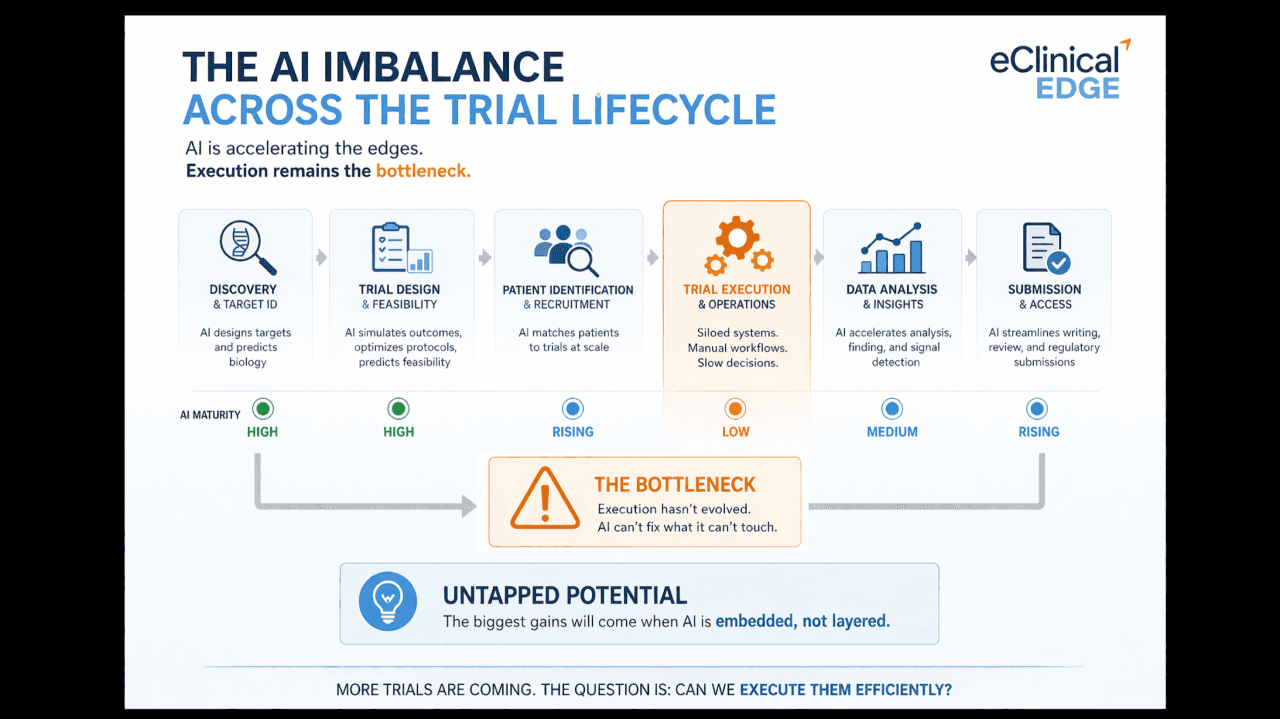
The emerging imbalance
If we step back, a pattern becomes clear:
Layer --→-- AI Adoption
Drug discovery --→- Accelerating rapidly
Patient recruitment --→-- Now showing real-world validation
Trial execution --→-- Still largely unchanged
We are improving:
what enters the pipeline
how patients are matched
But not:
how trials are actually run
Why this matters (more than it seems)
Because these layers are not independent.
If upstream acceleration continues — and it will — then:
Clinical operations becomes the constraint.
More trials. More complexity. More data.
But the same:
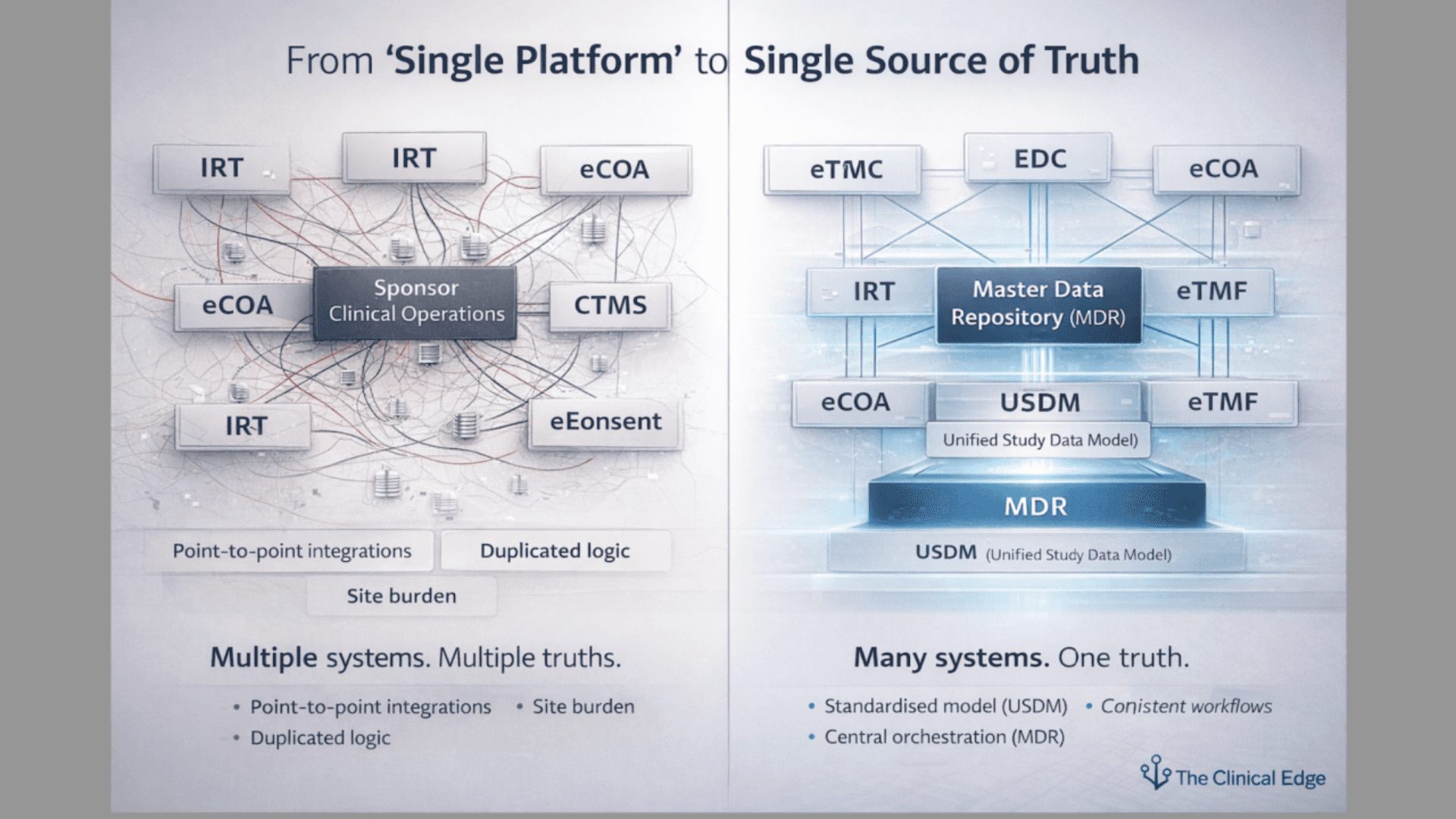
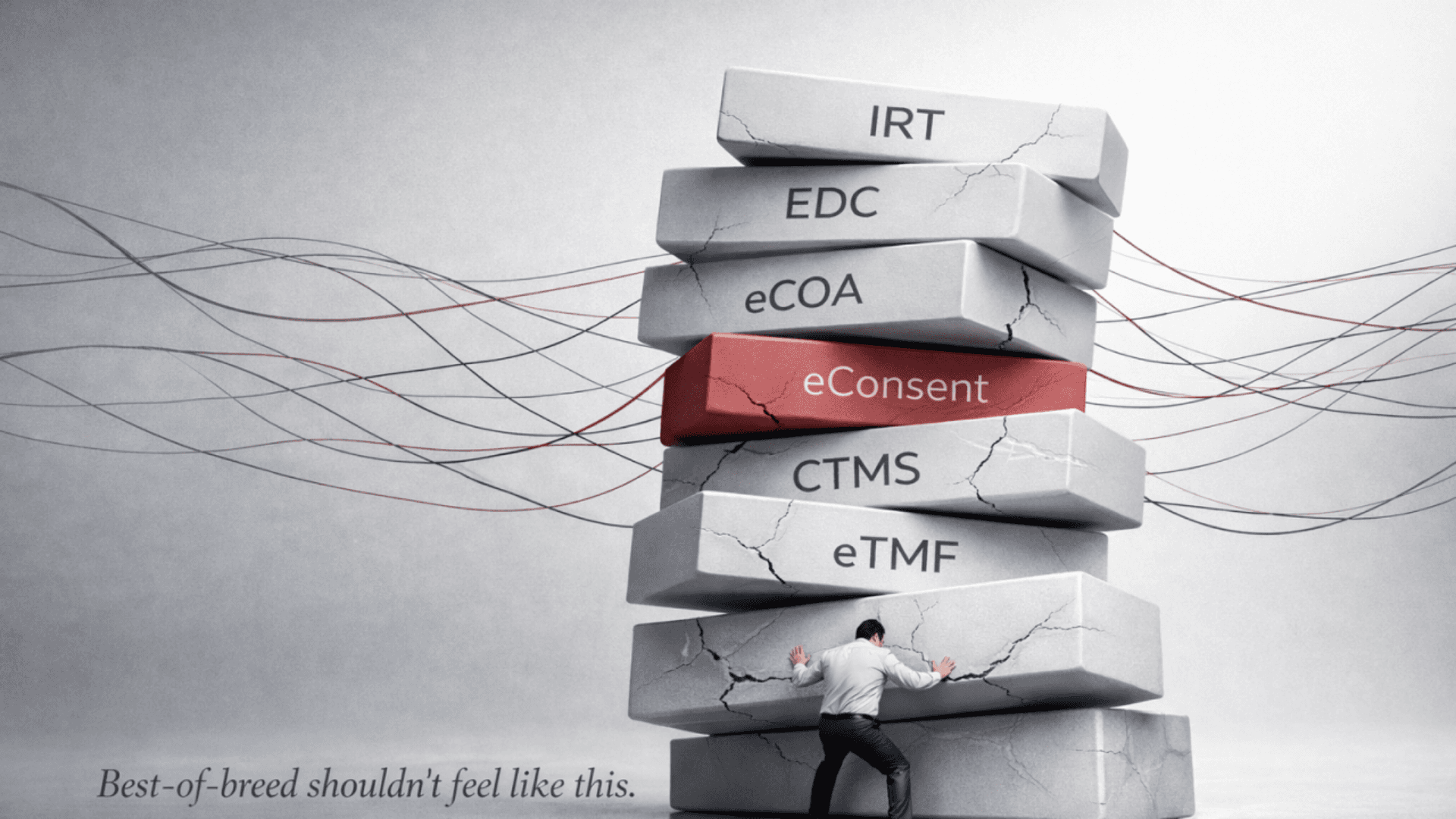
fragmented systems
manual interpretation
disconnected workflows
My take
I don’t think the industry has an AI adoption problem anymore.
I think it has a change tolerance problem.
We are comfortable with AI when it:
sits outside the workflow
supports decision-making
doesn’t require revalidation of core systems
We are less comfortable when it:
challenges how trials are designed
sits inside execution layers
requires rethinking system architecture
So we compromise.
We implement AI… …but keep it at arm’s length.
What happens next
If these three signals continue (and I believe they will), the next phase is inevitable:
1. Pressure on execution models
AI will continue to improve:
recruitment
feasibility
protocol design
Which will expose inefficiencies in execution faster
2. Shift from tools → orchestration
Adding another AI tool won’t solve this
The shift will be toward:
connected systems
shared protocol understanding
orchestration layers that can use AI meaningfully
3. Redefinition of “acceptable risk”
Regulators and sponsors will need to move from:
“avoid AI in execution”
To:
“define where AI is acceptable — and how it is governed”
The bottom line
AI is no longer knocking at the door of clinical trials.
It’s already inside:
identifying patients
shaping pipelines
influencing decisions
But it’s still being kept away from the core:
Execution.
And until that changes:
We won’t get transformation.
We’ll get optimisation.
References
Massive Bio. Landmark prospective study demonstrating AI-driven clinical trial matching at scale. Rutland Herald (2026). https://www.rutlandherald.com/news/business/massive-bio-publishes-landmark-prospective-study-demonstrating-ai-driven-clinical-trial-matching-at-scale-in/article_f3938018-8cf5-57fa-b84a-55cdcf4ec9c8.html
Artificial intelligence is welcome, but minimization isn’t: a clinical paradox. Clinical Trials Arena (2026). https://www.clinicaltrialsarena.com/sponsored/artificial-intelligence-is-welcome-but-minimization-isnt-a-clinical-paradox/
Recursion Pharmaceuticals update. Why Recursion (RXRX) is up after deepening Citeline partnership. Simply Wall St (2026). https://simplywall.st/stocks/us/pharmaceuticals-biotech/nasdaq-rxrx/recursion-pharmaceuticals/news/why-recursion-rxrx-is-up-108-after-deepening-citeline-partne
*Known Unknowns / Limitations
Limited transparency on how AI-driven matching performs across diverse populations and geographies
Unclear how quickly AI-driven discovery pipelines will translate into late-phase trial volume increases
Lack of public evidence on AI embedded directly into trial execution systems (EDC/eCOA/IRT)
About

Delivering independent journalism, thought-provoking insights, and trustworthy reporting to keep you informed, inspired, and engaged with the world every day.
Featured Posts