The Hidden Cost of Fragmentation
There’s a quiet lie circulating in clinical trials. It’s dressed up as sophistication. It sounds like maturity. It often appears in RFPs.

Or: why your “best-of-breed” stack might be your most expensive decision
There’s a quiet lie circulating in clinical trials.
It’s dressed up as sophistication. It sounds like maturity. It often appears in RFPs.
“We’ve selected best-of-breed systems across our stack.”
On paper, this reads like excellence. In practice, it often behaves like entropy.
Because while each system may be excellent in isolation, the space between them is where trials begin to quietly fall apart.
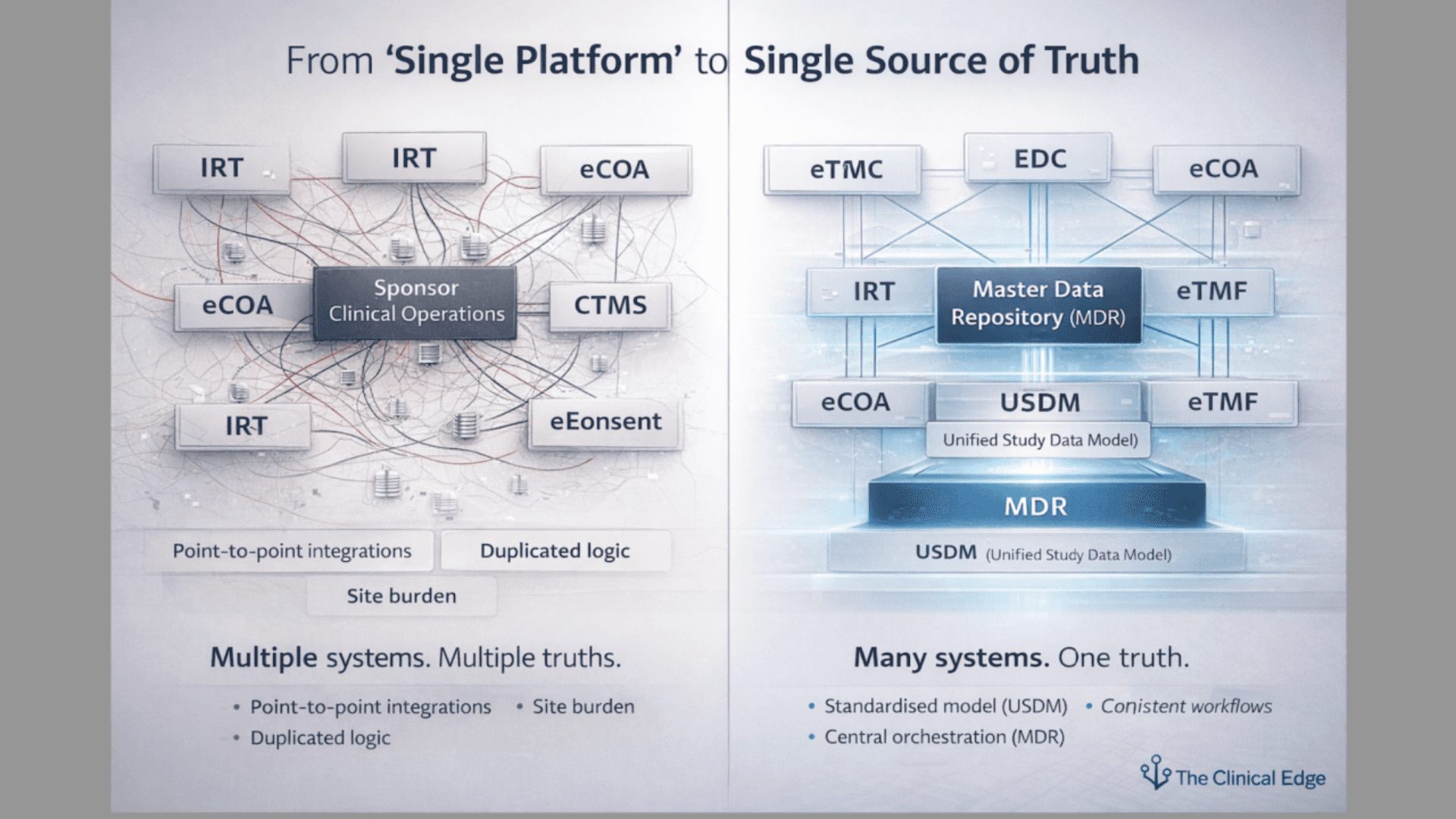
A typical sponsor environment today might include IRT/RTSM, EDC, eCOA, eConsent, CTMS, eTMF, safety systems, and participant engagement tools. Individually, these systems may be strong. Collectively, they are often poorly aligned.
Research led by Kenneth Getz demonstrates that protocol design complexity—and therefore execution burden—continues to rise, with increases in endpoints, procedures, countries, and data volume all contributing to heavier operational demands.¹
Each additional system introduces:
another data model
another workflow
another interpretation of “truth”
And, crucially, another integration point that can fail quietly.
Fragmentation Doesn’t Break Trials. It Slows Them to Death.
Fragmentation rarely shows up as a single point of failure.
Instead, it manifests as:
A visit scheduled in one system but not reflected in another
A patient completing an assessment outside the intended window
A supply shipment triggered using stale or incomplete data
A site reconciling multiple systems to answer one operational question
None of these events are catastrophic.
But together, they create what McKinsey & Company describes as structural inefficiency driven by disconnected workflows—small frictions that compound into meaningful delays and cost inflation.²
The Myth of the “Single Source of Truth”
The industry loves the phrase.
Every vendor promises it. Every sponsor wants it. No one really has it.
In fragmented environments, what exists instead is:
Multiple sources of partial truth, reconciled manually
Evidence from clinical operations research shows that increased protocol complexity correlates with longer cycle times, higher workload, and reduced execution efficiency, reinforcing the burden of managing disconnected systems.¹
Which leads to the uncomfortable reality:
The most expensive integration layer in your trial is often human beings.
Sites Feel It First (and Worst)
If you want to understand fragmentation, don’t ask the sponsor.
Ask the site.
The Society for Clinical Research Sites has repeatedly identified technology burden and system overload as key contributors to site dissatisfaction and inefficiency, particularly where multiple platforms require duplicate entry and fragmented workflows.³
In practical terms, this includes:
multiple logins per study
duplicate data entry
inconsistent workflows
unclear system ownership
Fragmentation at the system level becomes friction at the human level.
And friction, in clinical trials, is expensive.
The Financial Cost (That Rarely Gets Attributed)
Fragmentation costs are rarely labelled as such.
Instead, they appear as:
increased monitoring effort
higher query volumes
delayed database locks
supply inefficiencies
project management overhead
According to Deloitte, operational inefficiencies in clinical development represent a significant source of avoidable cost, driven more by process and system complexity than by scientific failure.⁴
Or more plainly:
We have become very good at budgeting around inefficiency.
Why This Problem Is Getting Worse
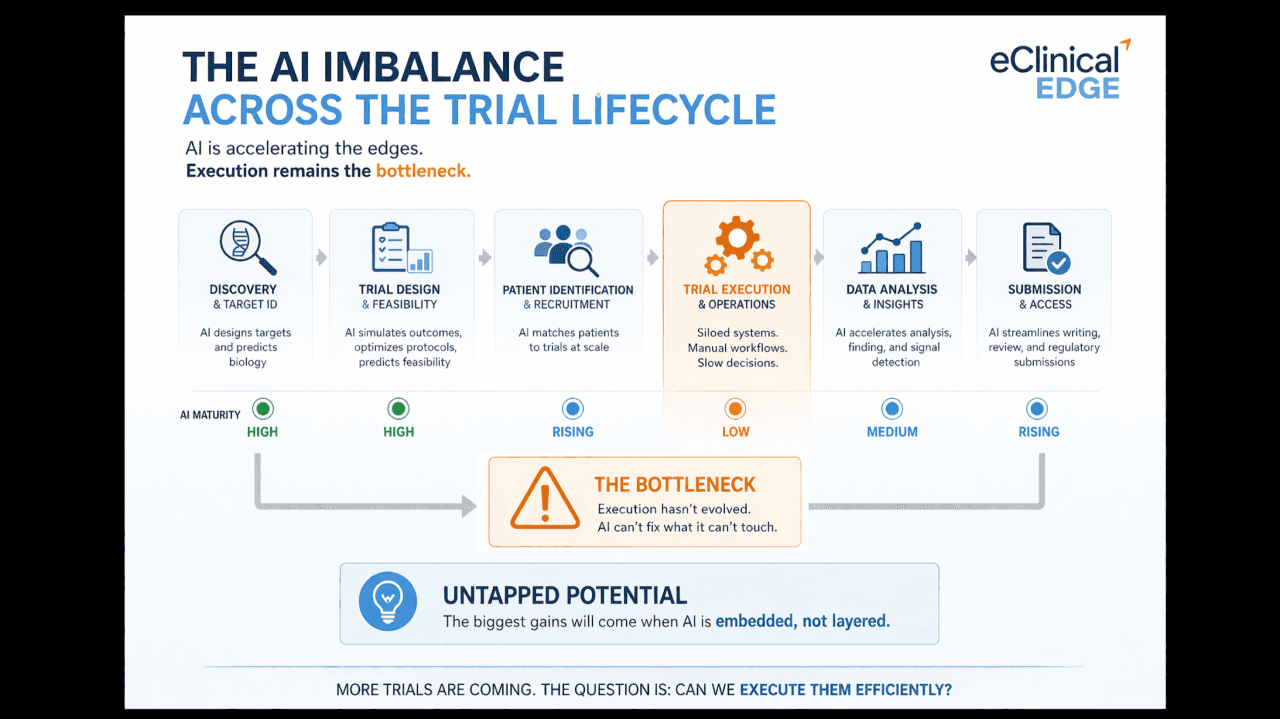
Innovation is accelerating fragmentation.
Each new capability—decentralised trials, digital endpoints, AI tools—often arrives as:
a new vendor
a new platform
a new dataset
Without coordination, innovation increases:
integration burden
inconsistency risk
operational complexity
The industry has solved for capability expansion. It has not yet solved for capability coordination.
A Subtle Shift in Thinking
The strategic question is changing.
From:
Which system is best?
To:
How do systems work together operationally?
This is where orchestration emerges:
Not replacement
Not forced consolidation
But coordination
A model where systems remain specialised, but workflows are unified.
Not a single system.
A single way of working.
Final Thought
Fragmentation is not a technical flaw.
It is an architectural choice.
One that has been rational, incremental, and well-intentioned.
But one that now carries a compounding cost:
delays no one can fully explain
burden no one explicitly owns
inefficiencies everyone has normalised
Until someone decides not to.
References
Getz, K. A. (2022). Protocol Design and Performance Benchmarks by Phase and by Oncology and Rare Disease Subgroups. Therapeutic Innovation & Regulatory Science. Open access: https://pmc.ncbi.nlm.nih.gov/articles/PMC9373886/
Tufts Center for the Study of Drug Development Impact Reports: Protocol design scope and execution burden trends https://csdd.tufts.edu/publications/impact-reports
Society for Clinical Research Sites Industry insights on site burden and technology fragmentation https://myscrs.org/resources/
McKinsey & Company Healthcare operational inefficiency and workflow fragmentation insights https://www.mckinsey.com/industries/life-sciences/our-insights
Deloitte Clinical development efficiency and cost analysis https://www2.deloitte.com/global/en/industries/life-sciences-and-healthcare.html
About

Delivering independent journalism, thought-provoking insights, and trustworthy reporting to keep you informed, inspired, and engaged with the world every day.
Featured Posts