>
>
The FDA Just Qualified Its First AI Drug-Development Tool And It Could Reshape How We Run Trials
The FDA Just Qualified Its First AI Drug-Development Tool And It Could Reshape How We Run Trials
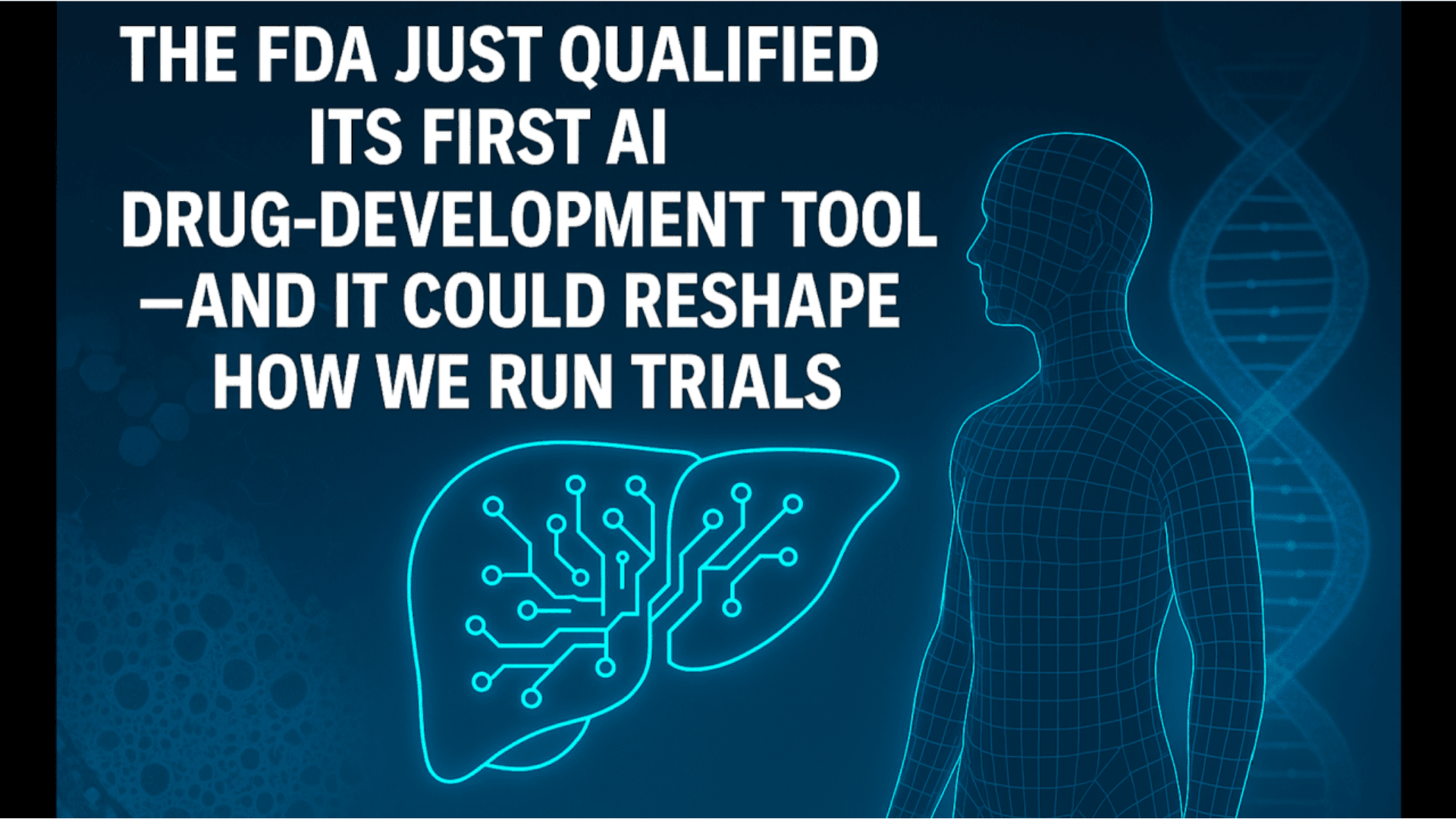
For years, the industry has talked about AI transforming clinical research. Now, the FDA has taken the conversation out of the hypothetical. The Agency has officially qualified the first artificial-intelligence tool for use in liver-disease drug development: a cloud-based system called AIM-NASH that reads and scores liver-biopsy images.
For years, the industry has talked about AI transforming clinical research. Now, the FDA has taken the conversation out of the hypothetical.
The Agency has officially qualified the first artificial-intelligence tool for use in liver-disease drug development: a cloud-based system called AIM-NASH that reads and scores liver-biopsy images.
This isn’t an approval for clinical care. It’s more interesting than that.
Qualification means any sponsor running an appropriately designed trial can now use this AI as part of their evidence package — no bespoke negotiation, no one-off justification, no regulatory hand-wringing. It’s a signal: AI has crossed the threshold from “promising” to “trusted infrastructure” in the eyes of the regulator.
And for MASH (formerly NASH) — one of the most challenging, failure-ridden therapeutic areas in the pipeline — this could be the beginning of a fundamentally different operating model.
What AIM-NASH Actually Does
AIM-NASH uses machine-learning models to analyse digital biopsy slides and quantify hallmark features of liver disease: steatosis, inflammation, ballooning and fibrosis.
Until now, these same slides required multiple expert pathologists, multiple reads and the inevitable variability that comes with human interpretation.
AI doesn’t get tired. It doesn’t reinterpret criteria on a Tuesday differently than on a Thursday. It standardises. It scales. It accelerates.
FDA’s determination that AIM-NASH performs on par with expert pathologists is the crux here. In a field where misclassification can derail multimillion-dollar trials, an AI capable of delivering consistency at speed is more than a convenience, it’s a structural upgrade.
Why This Matters for Trial Timelines
MASH trials are long, expensive and operationally fragile. The reliance on invasive biopsies and subjective scoring has historically slowed everything from enrolment to interim analyses.
AIM-NASH doesn’t change the need for biopsies but it does streamline the most manually intensive part of the process.
Faster reads. Fewer adjudications. More consistent scoring. If adopted widely, this could compress timelines and materially reduce the cost per programme.
Some analysts forecast that AI-enabled pathology could cut development time and cost by half within several years. Even if reality lands somewhere short of that ambition, the direction of travel is clear: the future of evidence generation is automated, standardised and cloud-native.
A Broader Signal for AI in Drug Development
This qualification is about more than hepatology. It’s a precedent.
Regulators are increasingly open to AI tools that support trial efficiency, reduce noise and strengthen interpretability of endpoints. The question is no longer if AI will be embedded into trial workflows but how quickly, how widely, and under what governance.
AIM-NASH shows what a credible path through that governance looks like: well-designed validation datasets, transparent model performance, and a clear use case with direct impact on trial conduct.
Expect more tools to follow in oncology imaging, ophthalmology, dermatology, neurology, and any field where pattern recognition limits throughput.
Implications for Global Research Ecosystems
Fatty-liver disease is not a U.S. problem; it’s a global one. Regions with limited access to expert hepatic pathologists often struggle to participate in high-quality trials, not because of patient scarcity, but because of specialist-capacity constraints.
Cloud-based AI tools change that calculus.
With the right infrastructure and regulatory alignment, sponsors could open high-value trial sites in regions that were previously under-represented. Greater global inclusivity, faster recruitment, and improved data quality aren’t aspirational, they’re operationally logical once the bottleneck of expert manual scoring is removed.
Countries with growing clinical-trial ecosystems stand to benefit from this shift if digital infrastructure keeps pace.
What Happens Next
The industry will now be watching three things closely:
Real-world performance How AIM-NASH behaves under real trial conditions, across scanners, staining differences, and global biopsy practices.
Uptake across sponsors and CROs Adoption will depend on integration effort, cost, and confidence that AI reduces, not introduces, variability.
Regulatory harmonisation Whether EMA, MHRA and others follow the FDA’s lead, and whether similar tools secure qualification across therapeutic domains.
One thing is certain: the operational fabric of clinical trials is changing. Workflow automation isn’t a future state it’s arriving through the front door of the regulator.
And when the FDA starts qualifying AI as standard trial machinery, the rest of the ecosystem adjusts.
References
About
Delivering independent journalism, thought-provoking insights, and trustworthy reporting to keep you informed, inspired, and engaged with the world every day.
Featured Posts