Understanding the New E6(R3) ICH GCP Regulations - in 4 minutes -
Change is in the air. On 6 January 2025, ICH released the final version of E6(R3) Good Clinical Practice (GCP). The Principles & Annex 1 are effective from 23 July 2025 in regions like the EU. (ICH Database) If you thought E6(R2) was modern enough, think again. This update isn’t just tweaking words it’s reframing GCP for trials built today, not 2016.
Change is in the air. On 6 January 2025, ICH released the final version of E6(R3) Good Clinical Practice (GCP). The Principles & Annex 1 are effective from 23 July 2025 in regions like the EU. (ICH Database)
If you thought E6(R2) was modern enough, think again. This update isn’t just tweaking words it’s reframing GCP for trials built today, not 2016.
The Key Changes You Need to Know
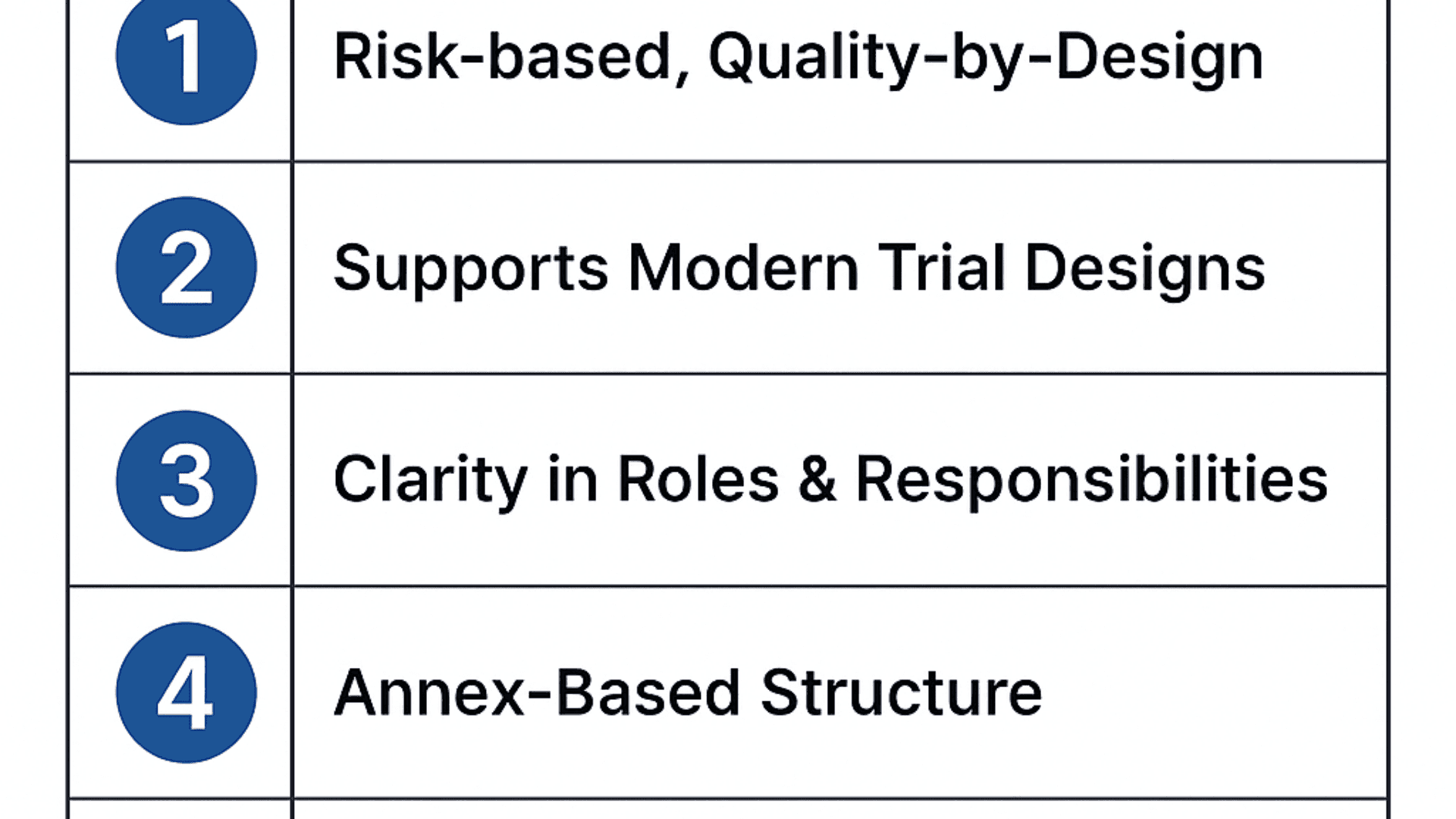
Risk-based, Quality-by-Design (QbD) E6(R3) explicitly embeds risk management and quality into trial design from the start: protocols, oversight, monitoring, everything now demands proactive thinking. (WCG)
Supporting Modern Trial Designs & Technologies The guideline now accommodates decentralised trials, uses of real-world evidence/data, remote monitoring, eConsent and eSource. Technology isn’t optional t’s expected. (CITI Program)
Clarity in Roles, Responsibilities & Oversight Sponsors, investigators, service providers all have sharpened accountability. Delegation must be documented; oversight must be proportional to risk. IRBs/IECs have clearer obligations; essential records & audit trails get new attention. (WCG)
Annex Structure & Scope E6(R3) has reorganised into a common Principles & Objectives document, Annex 1 for “traditional” interventional trials, and Annex 2 (still draft) for non-traditional, decentralised, adaptive designs. (European Medicines Agency (EMA))
What This Means for You (Sponsors / CROs / Investigators)
Gap assessments now required: weave the new expectations into your SOPs, risk registers, data governance, and consent processes.
Training + culture shift: everyone from site staff to investigators needs to understand what “proportional risk” looks like. No more one-size-fits-all compliance.
Infrastructure & tech readiness: remote monitoring systems, secure eConsent platforms, version control, metadata, audit trails. These are now front & centre.
Timeline urgency: EU regions have a July 23, 2025 implementation date for Principles + Annex 1. Other regions (via ICH member states) will follow. Don’t wait. (Amsterdam UMC)
Conclusion
ICH E6(R3) is the biggest refresh in Good Clinical Practice in nearly a decade. It’s not just an update it’s more of a reset.
If you want your trials to be ethical, efficient, data-credible, and fit for the digital age, the time to act is now. Review, adapt, and embed these updates, not as checkboxes, but as the backbone of how you think about clinical quality and participant protection.
Reference
ICH (2025). Guideline for Good Clinical Practice E6(R3). Final version adopted 6 January 2025. Available: https://database.ich.org/sites/default/files/ICH_E6%28R3%29_Step4_FinalGuideline_2025_0106.pdf (ICH Database)
Amsterdam UMC. (2025). ICH GCP Guideline E6-Revision 3, 2025. Amsterdam UMC Research Roadmap. (Amsterdam UMC)
The Revamped Good Clinical Practice E6(R3) Guideline. (2023). Bhatt, A., et al. PMC article. (PMC)
No regulatory professionals were accosted in the research and writing of this article. I considered it though.
About

Delivering independent journalism, thought-provoking insights, and trustworthy reporting to keep you informed, inspired, and engaged with the world every day.
Featured Posts