>
>
When Robots Play Scrabble with Your Trial Data: Can AI Clean Faster, Smarter and Still Keep Regulators Smiling?
When Robots Play Scrabble with Your Trial Data: Can AI Clean Faster, Smarter and Still Keep Regulators Smiling?
Imagine clinical data as a scrabble board: chaotic, unpredictable, overloaded with random letters (i.e. bad entries, missing values, inconsistencies). Now imagine an AI-powered robot swoops in, rearranges the mess, and finishes your word (er, dataset), all before you finish that second espresso. Welcome to the wonderful weird world of AI-assisted clinical data cleaning where speed, precision, and regulatory peace-of-mind are all on the table. But is your cushy data manager at risk of being swapped for a bot? Not exactly… yet. Let’s unpack this.
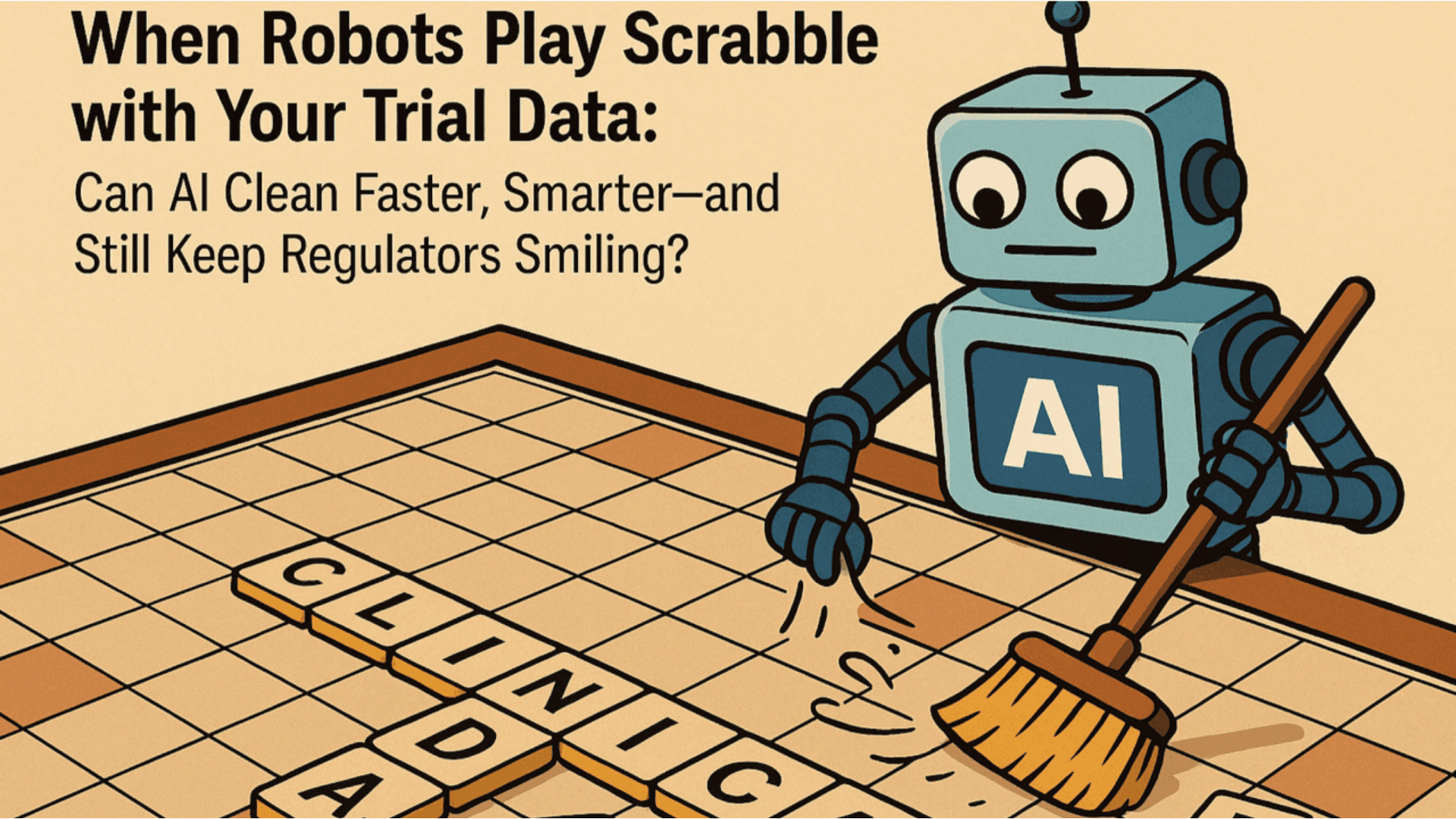
Imagine clinical data as a scrabble board: chaotic, unpredictable, overloaded with random letters (i.e. bad entries, missing values, inconsistencies). Now imagine an AI-powered robot swoops in, rearranges the mess, and finishes your word (er, dataset), all before you finish that second espresso. Welcome to the wonderful weird world of AI-assisted clinical data cleaning where speed, precision, and regulatory peace-of-mind are all on the table. But is your cushy data manager at risk of being swapped for a bot? Not exactly… yet. Let’s unpack this.
1. The Turbocharged Turbocharge: Octozi's 6× Speed and 6× Smarter
A groundbreaking study on Octozi, a hybrid AI platform powered by LLMs plus domain heuristics, demonstrated incredible dramatic improvements: cleaning throughput exploded by 6.03-fold, while error rates plunged from 54.7% to 8.5%—a 6‑plus‑fold accuracy boost. Bonus: false-positive queries dropped 15.5‑fold, meaning fewer headache‑inducing queries sent to trial sites. Sponsors could save millions and shave days or even weeks off database lock timelines. Pretty wild. (arXiv)
2. From Deterministic to Stochastic: Let the AI Surprise You
Gone are the days when data cleaning meant a rigid, rule-based “if-this-then-that” for every glitch. Enter AI-powered stochastic methods: probabilistic, adaptive, and comfortable with noise. These ML models identify anomalies that rule-based systems might miss. Sure, you get some false alarms initially, but with a pinch of human feedback, the AI learns fast. Your data cleaning becomes smarter, not just faster. (Applied Clinical Trials)
3. The Evolution: From Clinical Data Management to Clinical Data Science
A 2025 scoping review revealed that clinical data management (CDM) is rapidly evolving into clinical data science, think NLP, predictive analytics, risk-based monitoring, even blockchain. We're not just cleaning; we’re analysing, anticipating, and optimising. But beware: with great power comes great responsibility (have to quote Uncle Ben when I can - bonus points if you comment with the reference). So let’s keep those processes transparent, auditable, and appealing to regulatory Sherlocks. (dovepress.com)
Conclusion
So there you have it. AI is not just scrubbing your scrabble board it’s doing it with flair, speed, and fewer mistakes. But rather than replace human data managers, it hands them a shiny new magnifying glass to focus on strategy, interpretation, and insight. The real quest? Blending AI's raw horsepower with human nuance, all while keeping the regulators comfortably nodding. Ready to embrace your data-cleaning robo‑colleague without losing your quirky human edge?
References
Purri, M., Patel, A., & Deurrell, E. (2025). Leveraging AI to Accelerate Clinical Data Cleaning: A Comparative Study of AI-Assisted vs. Traditional Methods. Demonstrated 6‑fold throughput increases, 6.44‑fold accuracy improvement, and 15.48‑fold drop in false positives. (arXiv)
Thukral, A., & Bhardwaj, S. (2025). Revolutionizing Clinical Data Management: The Leap from Deterministic to AI‑Powered Stochastic Methods. Explores how AI's probabilistic models can uncover subtle anomalies, with adaptive learning through human feedback. (Applied Clinical Trials)
Musik, S. (2025). Bridging the Past and Future of Clinical Data Management. A scoping review transitioning CDM into clinical data science, highlighting NLP, predictive analytics, risk-based monitoring, blockchain, and patient-centric wearables. (dovepress.com)
About
Delivering independent journalism, thought-provoking insights, and trustworthy reporting to keep you informed, inspired, and engaged with the world every day.
Featured Posts