The Hidden Tax of “One More System”
There’s an assumption in clinical trials that doesn’t get challenged nearly enough: If each system is good… then more systems must be better. More specialised. More powerful. More “best-of-breed”. But spend a day at a clinical trial site, and that logic starts to unravel.

There’s an assumption in clinical trials that doesn’t get challenged nearly enough:
If each system is good… then more systems must be better.
More specialised. More powerful. More “best-of-breed”.
But spend a day at a clinical trial site, and that logic starts to unravel.
The Morning Ritual Nobody Designed
A site coordinator logs in.
Not once. But six times.
Different usernames. Different passwords. Different mental models.
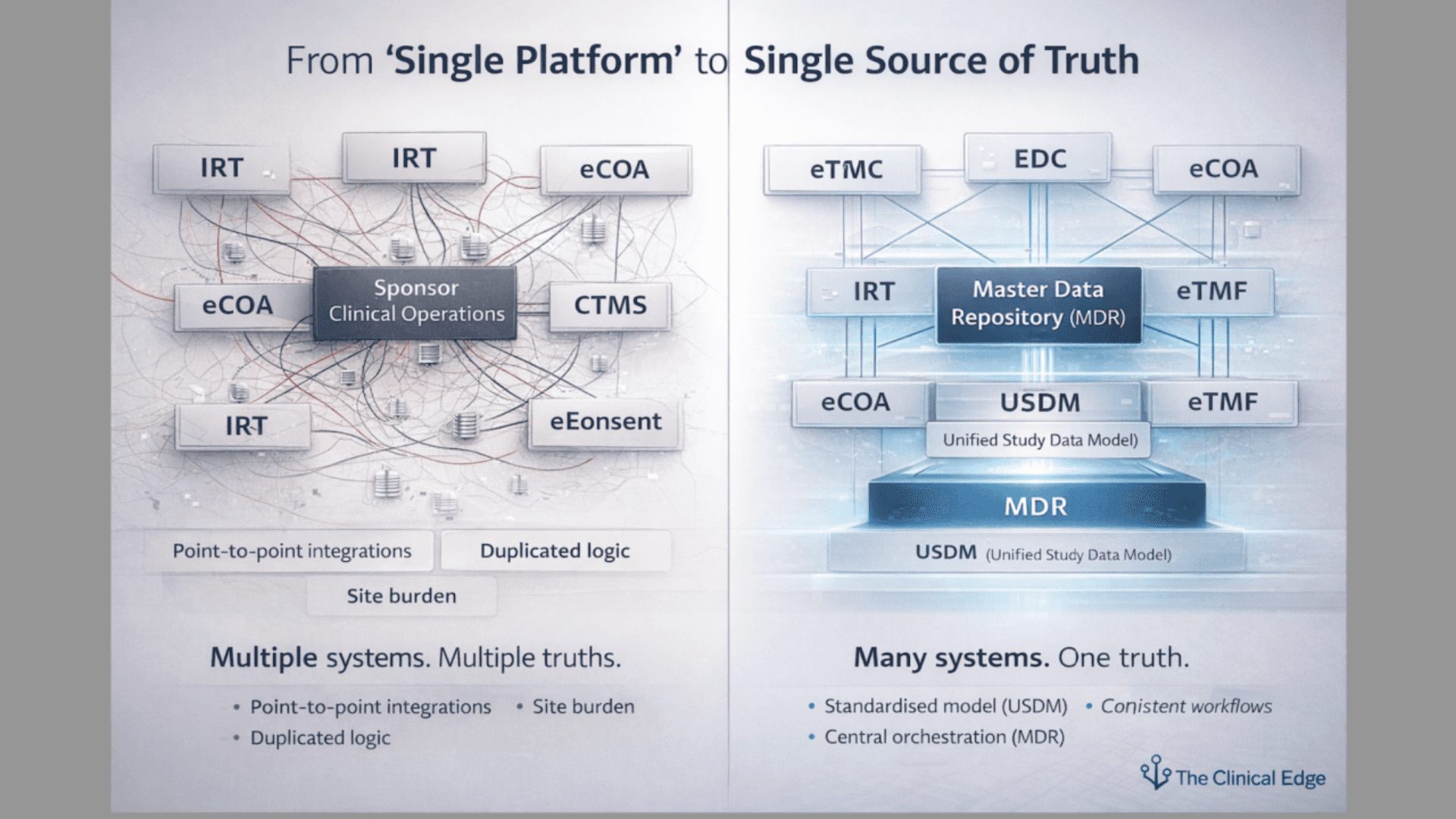
One system to randomise. Another to capture data. Another to manage outcomes. Another to track visits.
And before a single patient is seen, the day has already begun with friction.
This isn’t anecdotal.
Studies and industry initiatives consistently highlight that fragmented systems and poor usability increase workload, errors, and inefficiencies at the site level.
And here’s the uncomfortable part:
None of these systems are broken.
This Is Not a Workload Problem
When sites struggle, the default diagnosis is predictable:
“They’re under-resourced.” “They need more training.” “They need better discipline.”
But that misses the point entirely.
Because the issue isn’t the amount of work. It’s the shape of the work.
When identical tasks — screening, enrolling, scheduling, reporting — are executed differently across every study…
You’re not increasing rigour.
You’re increasing cognitive load.
The Cognitive Tax We Don’t Measure
There’s a hidden cost in clinical trials that never appears in budgets:
The mental overhead of remembering how each study works.
Which system handles what? Which login applies here? Which workflow comes next?
It’s small, individually.
But across:
5+ systems
Multiple concurrent studies
Repeated training cycles
Hundreds of daily micro-decisions
…it compounds into something much bigger:
Decision fatigue. Delay. And ultimately, risk.
ICH E6(R3) explicitly reinforces that systems used in trials must be fit for purpose and usable, recognising that poor design directly impacts quality and execution.
When Innovation Becomes Multiplication
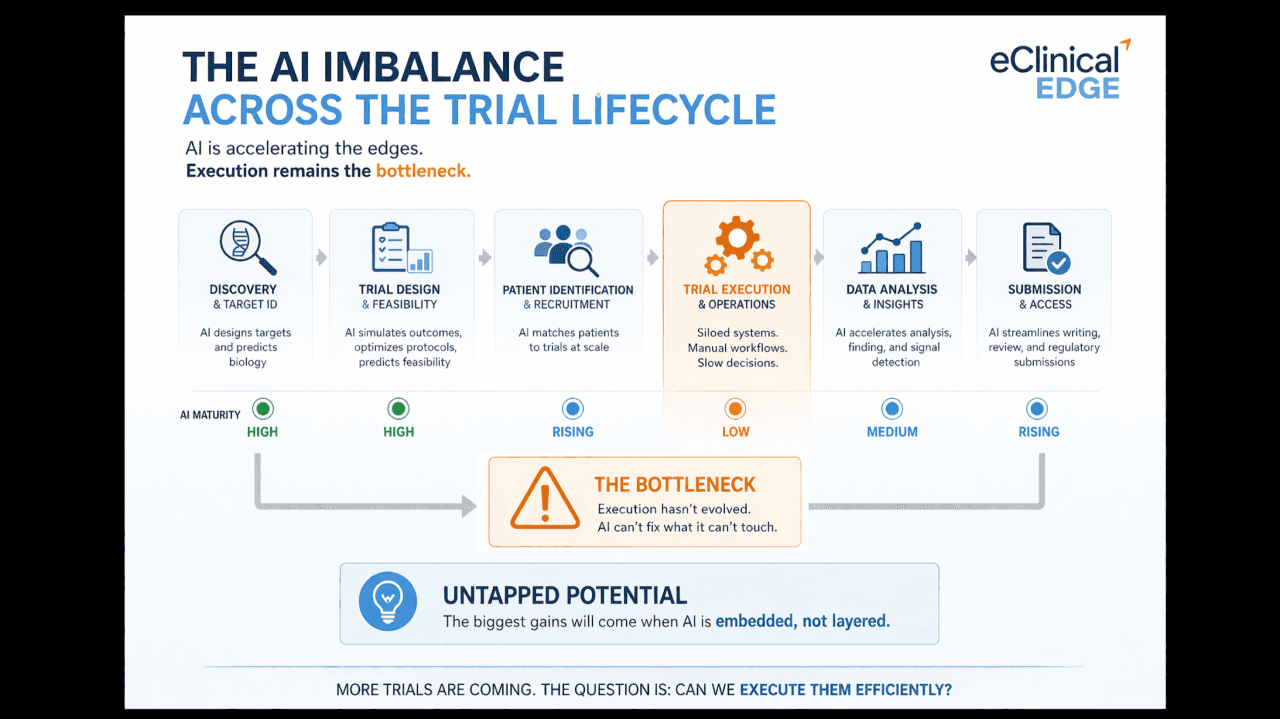
The industry often celebrates adding new technology:
New eCOA. New IRT. New EDC. New portal.
But rarely do we ask:
What happens when you layer them together?
Because from a sponsor perspective, each addition solves a problem.
From a site perspective, each addition creates one.
And over time, innovation stops looking like progress…
…and starts looking like duplication.
We Didn’t Design for the End User
Here’s the core truth:
Clinical trial systems are rarely designed around how work actually happens at the site level.
They’re designed around:
Study needs
Vendor capabilities
Procurement decisions
Functional silos
But not the person who has to make it all work together.
So the burden shifts.
From system → to human.
From architecture → to memory.
From design → to improvisation.
The Future Isn’t Fewer Systems
Let’s be clear:
The answer isn’t to eliminate systems.
Clinical trials are complex. Different functions require different capabilities.
The answer is something more fundamental:
Consistency. Coordination. Orchestration.
A world where:
One login replaces many
One workflow guides the process
One interface simplifies the day
Not by removing systems…
…but by making them behave as one.
The Real Question
We’ve spent years asking:
“Which system is best?”
Maybe it’s time to ask something better:
“What does this feel like to run?”
Because until we design clinical trials for the people actually delivering them…
We’re not reducing complexity.
We’re just moving it around.
References
TransCelerate BioPharma Inc. (2020–2023). Site Experience Initiative (SEI) https://www.transceleratebiopharmainc.com/initiatives/site-experience/
International Council for Harmonisation (ICH). (2023). ICH E6(R3) Good Clinical Practice Guideline https://www.ich.org/page/efficacy-guidelines
Tufts Center for the Study of Drug Development. Protocol complexity and its impact on clinical trial execution https://csdd.tufts.edu
Cousins, J. (2026). Clinical trial site burden discussion - https://www.linkedin.com/posts/jonathan-cousins_we-dont-talk-enough-about-the-reality-of-activity-7422938627619434496-Qga2?utm_source=share&utm_medium=member_desktop&rcm=ACoAAAWelmEBXz3yNZYWcXWv4VT15piuKJ8cK7E
About

Delivering independent journalism, thought-provoking insights, and trustworthy reporting to keep you informed, inspired, and engaged with the world every day.
Featured Posts