The Solution to the ‘Single Platform’ Myth?
How to fix fragmentation without pretending it doesn’t exist
How to fix fragmentation without pretending it doesn’t exist
For years, the industry has chased a simple idea:
One platform to run clinical trials.
One system. One interface. One place where everything lives.
It’s elegant.
It’s marketable.
And it’s fundamentally flawed.
The Myth We Keep Selling
The promise of a “single platform” assumes something that isn’t true:
That clinical trials can be reduced to a single system architecture.
They can’t.
Because trials are not one thing.
They are:
Supply chains (IRT)
Data capture engines (EDC)
Patient experience layers (eCOA, eConsent)
Operational control systems (CTMS, eTMF)
Each with different requirements. Different lifecycles. Different regulatory pressures.
Trying to collapse them into one system doesn’t remove complexity.
It just hides it.
And usually, it hides it badly.
So What Actually Breaks?
When we force a “single platform” mindset onto a multi-system reality, three things happen:
1. Fragmentation moves underground
Integrations become tighter, but more brittle. Dependencies increase. Change becomes slower.
2. Data risk quietly increases
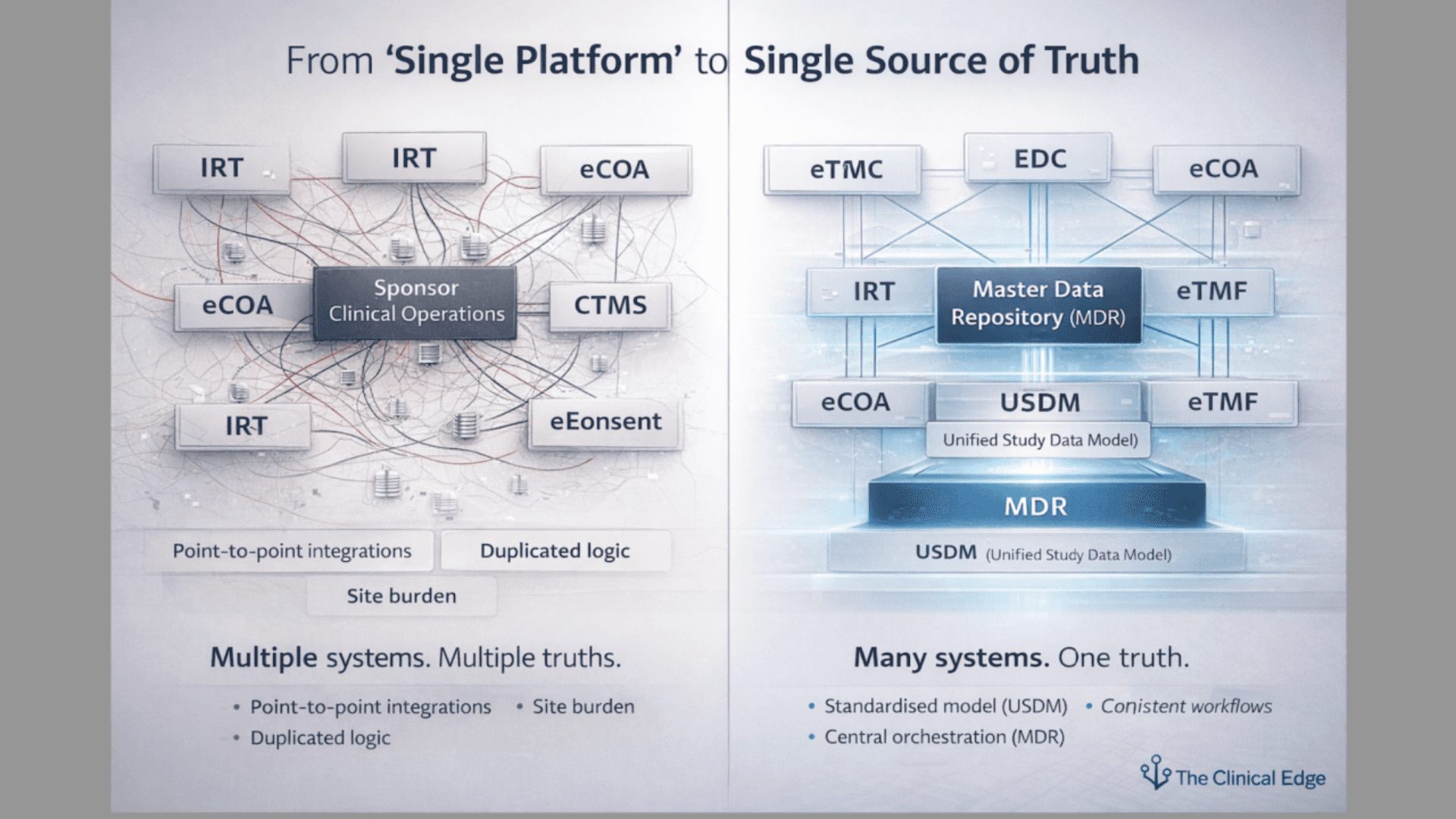
Multiple systems = multiple versions of truth.
Without a consistent data backbone, discrepancies aren’t eliminated.
They’re just harder to detect.
3. Sites pay the price
Different workflows. Different interfaces. Different ways of doing the same task.
And once again:
The system doesn’t absorb the complexity. The human does.
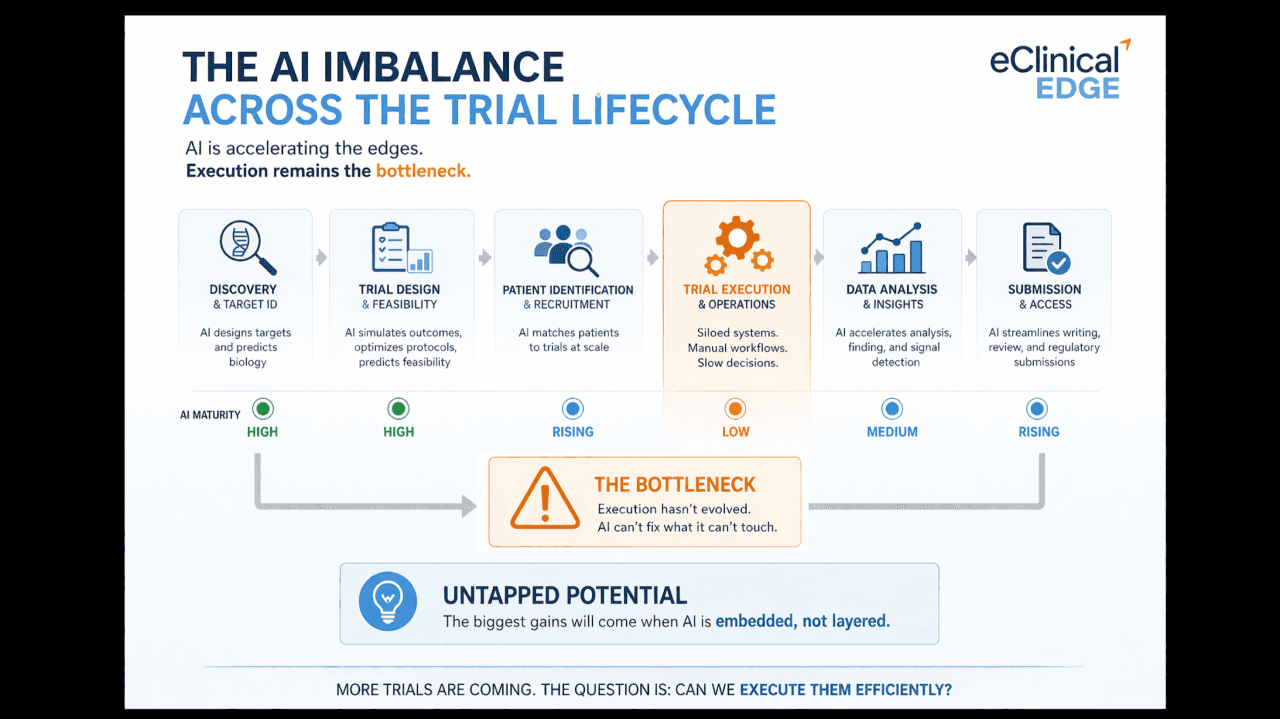
We’ve Been Solving the Wrong Problem
The industry has focused on:
→ Reducing the number of systems → Consolidating vendors → Building bigger platforms
But that’s not where the real problem sits.
Because fragmentation isn’t caused by how many systems you have.
It’s caused by how those systems understand and share data.
Enter USDM: A Common Language for Trials
The Unified Study Data Model (USDM) changes the conversation.
Not by replacing systems.
But by standardising how they speak.
USDM provides a consistent, structured way to represent:
Study design
Schedule of activities
Visits and procedures
Data collection expectations
Across systems.
Across vendors.
Across the entire study lifecycle.
In simple terms:
It separates the meaning of the trial from the systems that execute it.
And that’s a big deal.
Because once meaning is standardised…
Systems become interchangeable.
The Missing Piece: A Master Data Repository
USDM alone isn’t enough.
You need somewhere for that standardised truth to live.
Enter the Master Data Repository (MDR).
Think of it as:
A single, authoritative source of study logic — not owned by any one system.
Instead of:
EDC holding one version of visits
IRT holding another
eCOA holding a third
The MDR becomes the source of truth.
Systems don’t define the study.
They consume it.
What This Actually Fixes
1. Fragmentation (Without Removing Systems)
You can still use best-of-breed tools.
But they now operate from the same blueprint.
Consistency replaces chaos.
2. Data Risk (At the Source)
When all systems pull from a shared model:
→ Fewer discrepancies → Less reconciliation → Greater traceability
This aligns directly with regulatory expectations for data integrity under guidelines like ICH E6(R3).
3. Site User Fatigue (Where It Matters Most)
This is where it gets interesting.
Because once workflows are driven by a shared model:
Visits look the same across systems
Tasks follow the same logic
Training becomes reusable
The experience becomes:
Predictable. Repeatable. Learnable.
Not because there’s one system.
But because there’s one way of working.
This Is the Real Endgame
Not:
One platform
But:
One model One source of truth One operational experience
Delivered across multiple systems.
Why This Matters Now
The industry is at an inflection point.
AI. Automation. Decentralised trials.
All of it depends on one thing:
Clean, consistent, interoperable data.
Without that?
We’re just accelerating fragmentation.
The Shift Ahead
The winners in this space won’t be the ones who:
→ Build the biggest platforms
They’ll be the ones who:
→ Standardise the data → Decouple logic from systems → Orchestrate, rather than consolidate
Final Thought
We don’t need fewer systems.
We need systems that agree.
Because the future of clinical trials isn’t:
One platform to rule them all.
It’s:
Many systems. One truth.
References
TransCelerate BioPharma. Unified Study Definitions Model (USDM) Initiative https://www.transceleratebiopharmainc.com/initiatives/unified-study-definitions-model/
CDISC. Study Data Standards and Interoperability Framework https://www.cdisc.org/standards
International Council for Harmonisation (ICH). ICH E6(R3) Good Clinical Practice Guideline https://www.ich.org/page/efficacy-guidelines
Kush, R. et al. (2020). Electronic Health Data Standards in Clinical Research — npj Digital Medicine https://www.nature.com/articles/s41746-020-00312-3
ISO. ISO 14155: Clinical investigation of medical devices for human subjects (data integrity and system requirements context) https://www.iso.org/standard/71690.html
About
Delivering independent journalism, thought-provoking insights, and trustworthy reporting to keep you informed, inspired, and engaged with the world every day.
Featured Posts